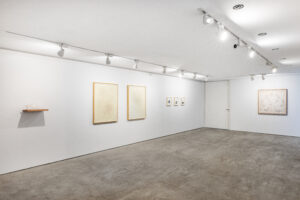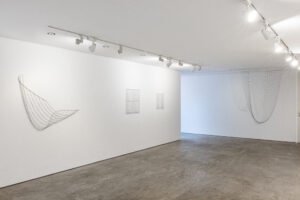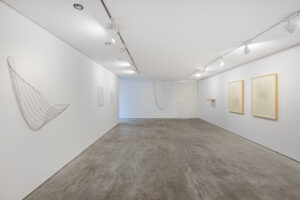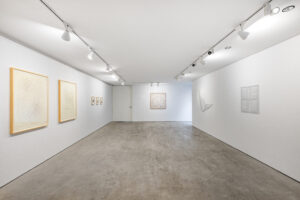

ethereal_ amalia giacomini | carla chaim | laura belém | marina weffort
10 jun - 22 aug_ 2026
Ethereal
Paula Borghi
From Ancient Greece until the end of the 19th century, scientists believed that, by observing the universe through a sufficiently powerful telescope, it would be possible to detect ether, which was then considered as real as water, earth, fire, and air. Regarded for centuries as the fifth element, ether was understood as an exceedingly pure physical substance that filled celestial space and the bodies of the stars. It was only at the beginning of the 20th century that it came to be identified as a substance composed of carbon, hydrogen, and oxygen atoms—something entirely different from what had previously been imagined. Even so, its meaning continues, to this day, to resonate as a metaphor for that which, within the realm of the invisible, is capable of permeating multiple spatialities.
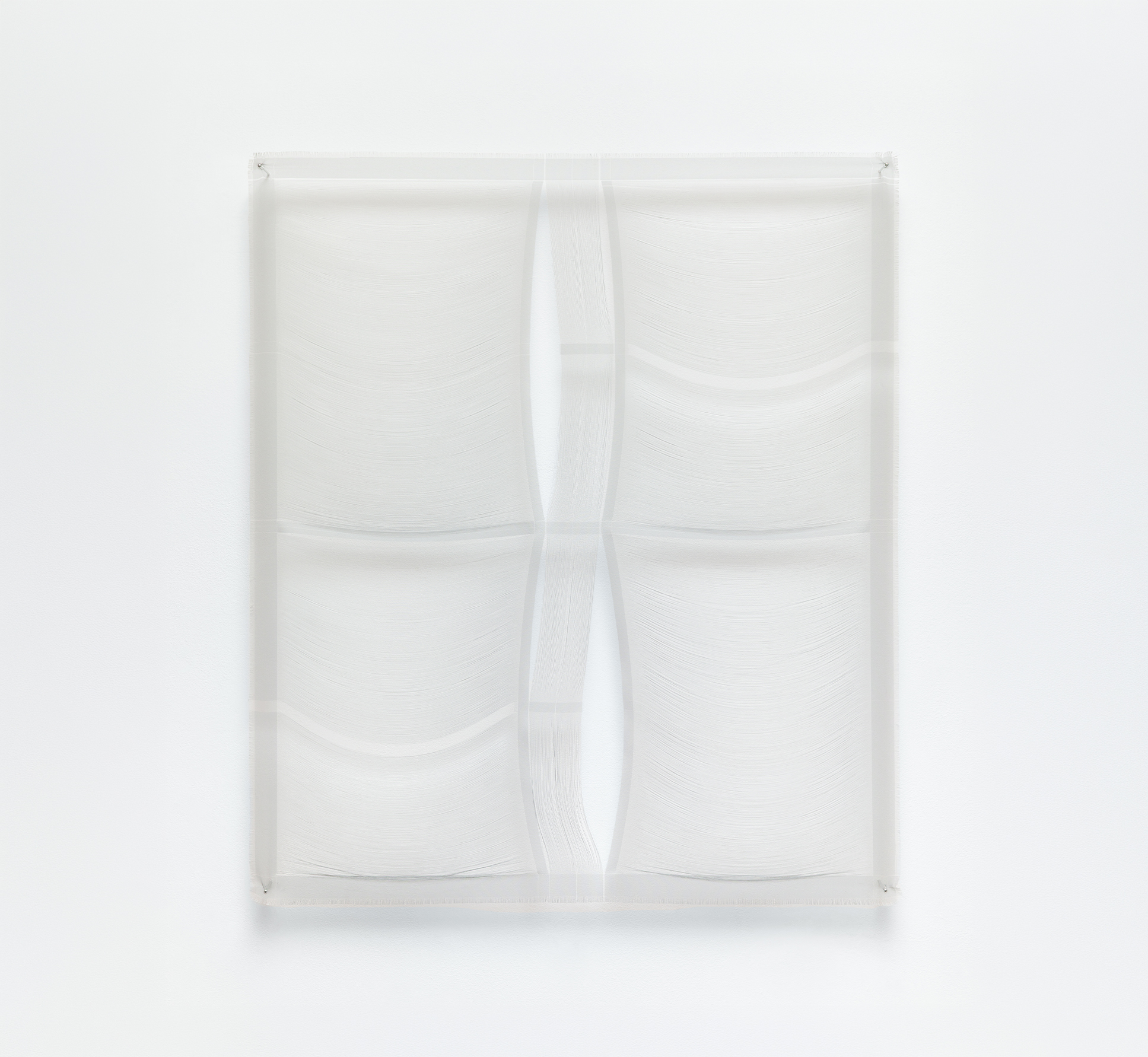
Drawing upon the poetic, formal, and holistic qualities of ether, the group exhibition Ethereal brings together works that articulate spaces filled with voids, or voids filled with space. Born in southeastern Brazil in the 1970s and 1980s, Amalia Giacomini, Carla Chaim, Laura Belém, and Marina Weffort are artists whose practices converge around the intangible, grounded in the understanding that, within the composition of a physical work, blank areas or the air permeating rigid matter are just as important as their opposites. It is through the realization that an empty glass is, in fact, filled with air that they observe the subtleties of the world.
Through practices rooted in the repeated execution of a single gesture, Carla Chaim uses both hands synchronously to draw white upon white, while Laura Belém creates graphite circles and perforates Japanese paper with incense, and Marina Weffort surgically removes thread after thread from fabric. Their processes emerge from a near-meditative bodily state. Although there is no literal representation of their identities, their presence exceeds the image as simulacrum, becoming ethereal. In Amalia Giacomini’s work, in turn, it is the viewer’s body that awakens a sensitivity to the artwork’s ethereal field, which transforms according to one’s point of view. Here, everything is volatile: with each step, the sculptural form shifts.
Beyond the ethereal presence of the body—a condition that permeates each artist’s practice in its own way—it is possible to perceive, in the works gathered here, drawing as a means of creating empty spaces filled by what has been either removed from or added to them, depending on one’s frame of reference. In other words, the absence of matter can only be conceived through its presence, and vice versa. Once again, it
is in the encounter between what is removed and what remains that the void ceases to signify absence and instead becomes foundation.
Suspended in a state of liminality, the works on view evoke the idea of ether as imagined by the ancients—except that, rather than a substance filling celestial space and the bodies of the stars, it now permeates the white cube and the artworks themselves. It is through this poetic intention that Amalia Giacomini, Carla Chaim, Laura Belém, and Marina Weffort inhabit the in-between space. As the poet Orides Fontela (1940–1988) once wrote: “Our atmosphere will never again be the same, for we sustain the flight that sustains us.
exhibitions images