

ArPa 2026
21 may - 31 may_2026
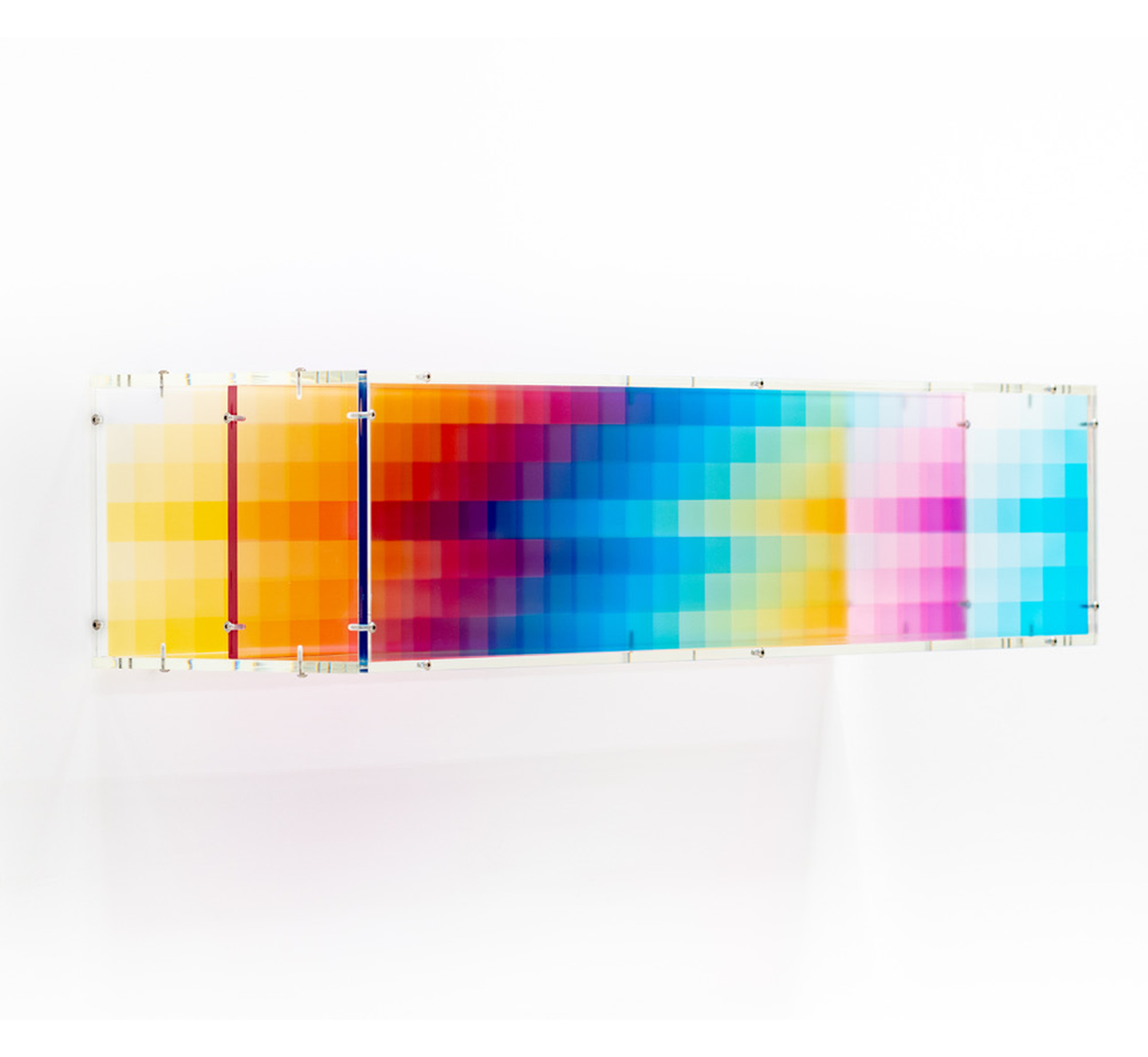
Wolfram Ullrich and Felipe Pantone are contemporary artists who, although coming from distinct aesthetic backgrounds, converge in a fascinating dialogue on perception, color, and space in art. Ullrich, rooted in the foundation of Concrete Art since the late 1980s, develops precise steel reliefs that challenge the two-dimensionality of painting. His work emerges from a rigorous process of conceptual planning and manual execution, where monochromatic color and geometry create optical phenomena: the surfaces appear to float or recede from the wall, subjecting the work to the viewer’s shifting perspective and transforming the act of observation into a continuous discovery of vanishing points and spatial tensions.
Felipe Pantone, in turn, began his practice through graffiti, calligraphy, and typography, platforms from which he gradually evolved his artistic language. He developed an abstract and geometric visual vocabulary intended to be both accessible and democratic, running parallel to contemporary technological discourse. His work focuses on reflecting upon the consumption of visual information in the digital age, employing abstraction through contemporary visual references such as infographics and technological “glitches.” Influenced by Op Art and Kinetic Art, especially by masters such as Carlos Cruz-Diez, Pantone uses a wide range of materials, from paint to digital screens, to explore chromatic saturation and the dematerialization of color.
The main convergence between the two artists lies in their demand for the viewer’s active participation. While Ullrich manipulates physical volume so that the observer’s movement completes the illusion, Pantone expands the kinetic legacy by incorporating the virtual, allowing the artwork itself, or the perception of it, to constantly shift. In this way, both artists use color and form to question the stability of the pictorial plane and of perceived reality.