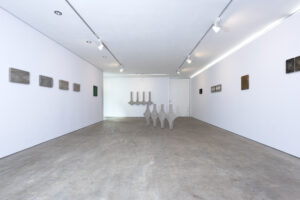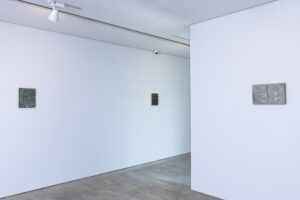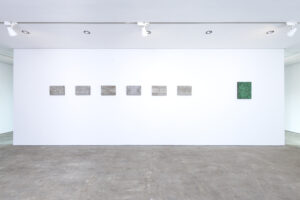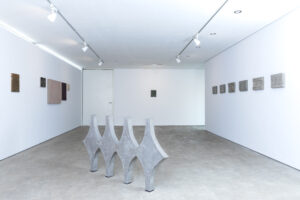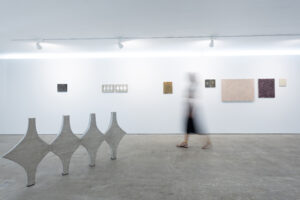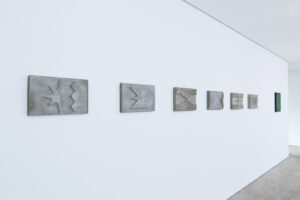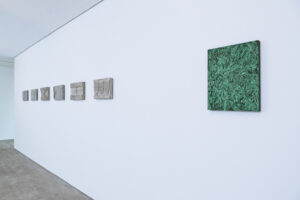

angular_ alan oju e guilherme callegari
05 feb - 28 mar_ 2026
Angular, an Act of Will
Lorraine Mendes
We may describe the angle as the form that makes a line hesitate and intentionally change direction: a sudden break that projects another direction from the same path, endowed with choice. It can also be understood as a point of encounter between two directions that do not merge but continue forward, each carrying the memory of this clash—or encounter—which graphically represents a silent gesture of space. The angle is also an opening, another way of seeing.
Alan Oju was born in 1985 in Santo André. Trained in History and holding a master’s degree in Visual Poetics, he develops an investigation that draws on cartographic methods to transform the experience of the city into interventions, images, performative actions, objects, paintings, and installations.
As he moves through the city of São Paulo, where he lives and works, Oju constructs a semantic field for his practice grounded in the refinement of form and in the limits imposed by human relationships with space. His poetics—situated between detours and devices—embody how these limits, both physical and economic, when expanded into the political domain, can be recoded into objects that translate the roughness of confrontation into the symbolic realm.
Through his work, we are invited to consider which gestures and whispers, amid urban chaos, allow us to recognize a small yet meaning-laden space where ideas of control, conflict, and tension are born, as well as those of direction, deviation, and beginning. The angular unit is not merely a measure, nor a number, nor a degree. It is the memory of an encounter, the record of something transient yet grounded.
Guilherme Callegari was born in Santo André in 1986. Trained in Graphic Design with an emphasis on typography, he has developed, over the course of fourteen years, a consistent investigation at the intersection of graphic design and painting. In his most recent production, painting assumes a central role as a field of formal inquiry. Although distant from his earlier practice, there remains a residual memory of a path once traveled—at times along large avenues, at others along the silent route of a painter.
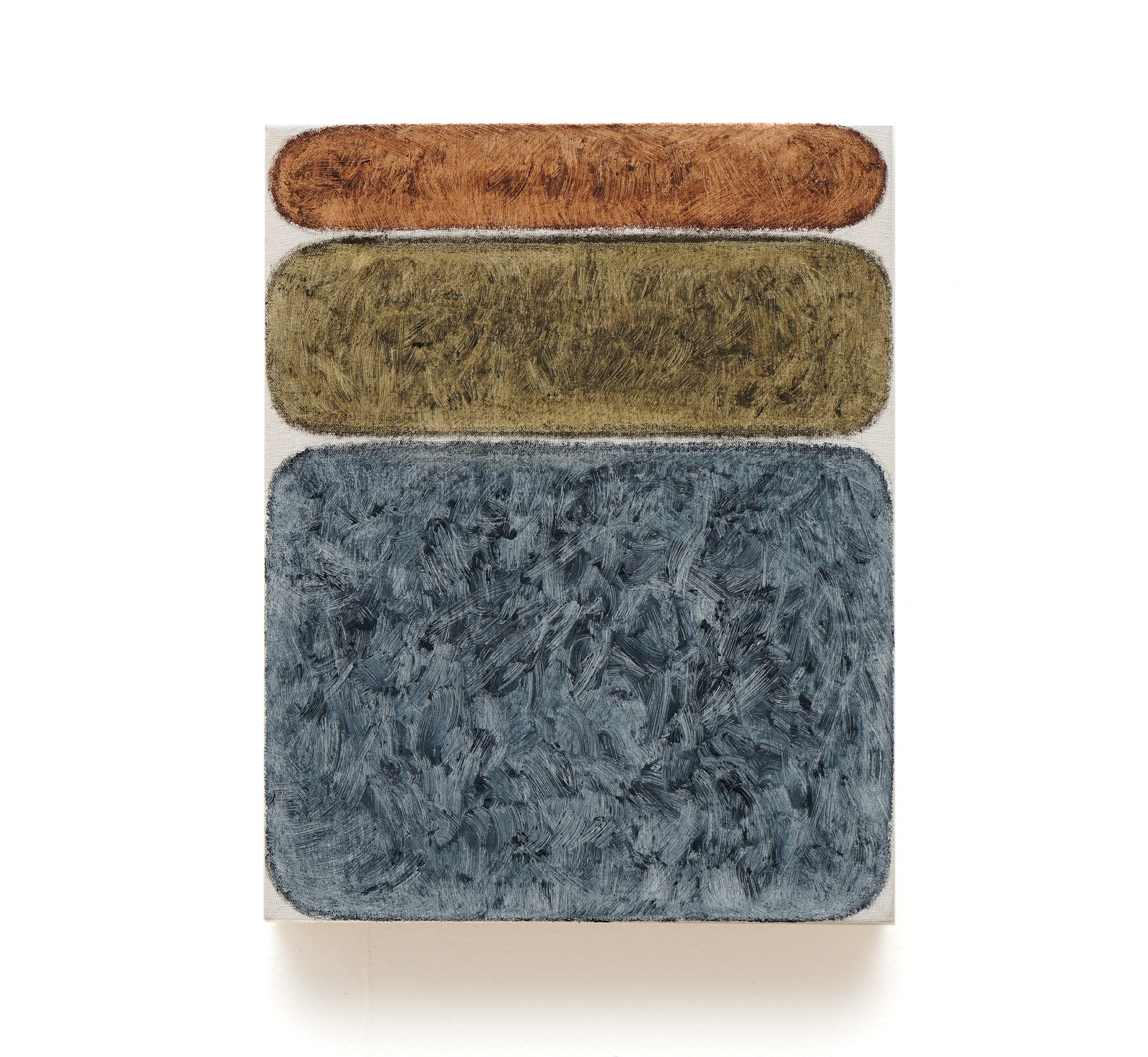
Callegari establishes a daily commitment to investigating facture and recognizes painting as an active agent. In building layers of linen, ground, and paint, he also acknowledges the time of the gesture and the care devoted to each glaze—an elastic and elusive temporality set against urban time, even as it is nourished by it. The angle is horizontalized into a field of color, with a detail that folds and reveals a curve.
In his work, the curve is passage, an accompanying body—a memory the artist carries with him, diluted along the way. This curve does not open an interval, nor does it create a corner. It creates time.
Within this space, the works of Guilherme and Alan enter into dialogue, and we may attempt to grasp a shared concern as if observing them through a wide-angle lens: the intention of expanding the field of vision across the work of two artists who nearly meet—in their biographies, in the paths of Greater São Paulo, in the resonances of their making, in angles and curves that indicate directions which converge even as they appear to move in opposition. They do not drift completely apart, nor do they merge; rather, they open between them an interval where the possibility resides that something might have continued straight ahead but chose instead to bend.
exhibitions images