

alexander apóstol_ the aftermath of democracy
12 nov - 22 mar_ 2027
Alexander Apóstol: The Aftermath of Democracy
Between the ousting of General Marcos Pérez Jiménez’s military dictatorship in 1958 and the election of Hugo Chávez as president in 1998, Venezuela experienced four decades of democracy. Within this relatively brief period, particularly when viewed against the broader timeline of historical processes and a country’s institutional traditions, different ideological groups managed to organize themselves around a range of political parties and platforms. Before these foundations were once again compromised by the concentration of power and the rise of Chavismo and its subsequent developments, culminating in a severe crisis that persists to this day, representative politics in Venezuela had been given an opportunity to rebuilt itself. In a departure from the fundamental principles of a republican state, popular sovereignty and a multiparty system emerged not as established norms, but rather as exceptions or windows of opportunity.
Alexander Apóstol (Barquisimeto, Venezuela, 1969) explores the fragility of democracy in his home country through the two works brought together in this exhibition. Following the participation in the 25th São Paulo Biennial: Iconografias metropolitanas (Metropolitan Iconographies) and the group exhibition Histórias latino-americanas (Latin American Histories) at the São Paulo Museum of Art (MASP), both in 2026, the artist presents a solo exhibition at Galeria Raquel Arnaud. The exhibition offers an in-depth examination of political ideologies and national identities in Latin America, taking geometric abstraction as its point of departure.
In Venezuela’s history, this artistic movement has been closely associated with the assertion of a revolutionary utopia, in contract to the triumphalist figurative imagery promoted by the dictatorial state. At the turn of the 1960s, artists such as Jesús Rafael Soto, Carlos Cruz-Diez, and Alejandro Otero developed a constructivist visual language characterized by vibrant colors and kinetic explorations. This artistic experimentation unfolded against a backdrop of oil-driven economic growth and the restoration of popular participation in public life.
At the time, given the country’s high illiteracy rate, which affected nearly a quarter of the population, elections were conducted using ballots that identified political parties by color. This electoral system gave rise to a chromatic imaginary that permeated everyday life, fostering a sense of political belonging and providing a visual means of political engagement. The civic education of a population that had been deprived for decades of the right to elect its representatives thus also involved a micropolitical dimension, rooted in the sensory experience of color.
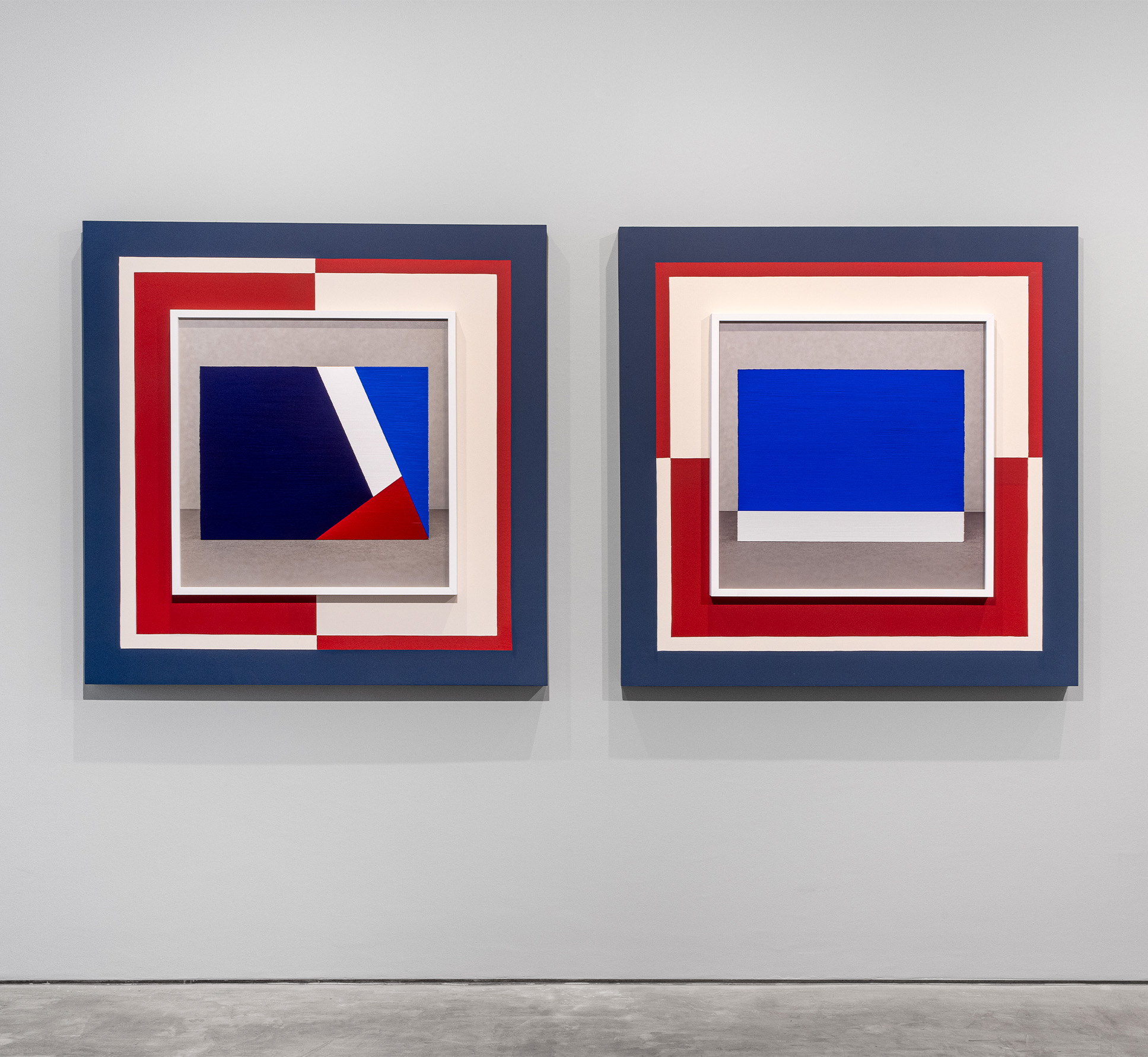
Apóstol revisits this period of optimism without overlooking the subsequent erosion of democratic institutions, marked by corruption scandals, political backroom dealings, and the dissolution of minority organizations. In Colour is My Business (2012-2026), a photographic polyptych depicts a single voting booth reproduced as a scale model. The tonal variations across the walls reveal color schemes that combine and merge, suggesting an abstraction rooted in successive party mergers and the resulting erasure of political identity. Despite its aesthetic and architectural density, the work invites us to place our faith in what remains visually intact: the intimacy of an enclosed space or the prominence of a small platform, both capable of safeguarding individual rights and projecting the agency of individuals within society.
In Partidos políticos desaparecidos (Disappeared Political Parties) (2018/2026), the artist creates paintings based on actual electoral ballots, erasing their texts and numbers while preserving only their graphic structure. He then photographs these paintings, presenting them as images in their own right. In the installation, these photographic records are superimposed over geometric reliefs rendered in solid colors, which, in turn, partially obscure a third and final layer of abstract forms painted directly onto the wall. The mural extends beyond the picture plane and into space, a gesture that has traversed social and art history since the second half of the twentieth century as a form of symbolic invocation.
While the representation of an absent document evokes lost memories and rights, the volumes projecting from the walls and reaching toward our bodies in the gallery belong to the present, affirming our presence. Within this interplay of paradoxes, the past opens onto possible futures, while visual exuberance—a defining feature of propaganda and the exercise of hegemonic control—emerges as a strategy that draws us towards counter-narratives and emancipation.
In their own distinct way, both works have the potential to reflect reality and encourage critical, proactive engagement forging connections between the Venezuelan context and other comparable experiences, particularly across Latin America. In art and in life, Apóstol’s works invite us to take a seat and become “participants,” echoing Hélio Oiticica’s call in his “environmental program.”1 In Brazil, where the legacy of Neoconcretism remains alive, yet the democratic compact also continues to face recurring threats—a central concern in the most recent presidential elections—the call to critically examine the narratives that shape our understanding of the world is particularly relevant and urgent.
Since Brazil’s return to democracy in 1985, the phrase “celebration of democracy”2 has become a familiar refrain in political campaigns and popular discourse surrounding elections. Yet, in the face of the structural and systemic crises confronting the institutions of representative democracy in Brazil, across Latin America, and around the world, and given the growing efforts required of individuals and organized groups to defend them, this sense of celebration can never be entirely free from the hangover of the day after.
Ana Maria Maia, October 2026
1 Hélio Oiticica. “Programa Ambiental”. In: Luciano Figueiredo, Lygia Pape, Waly Salomão (Org.). Aspiro ao grande labirinto. Rio de Janeiro: Rocco, 1986. p. 78-81.
2 Lucilia de Almeida Neves Delgado. “Diretas-já: vozes das cidades”. In: FERREIRA, Jorge; DELGADO, Lucilia de Almeida Neves (org.). O Brasil republicano: o tempo da ditadura — regime militar e movimentos sociais em fins do século XX. Rio de Janeiro: Civilização Brasileira, 2007, p.413-4.