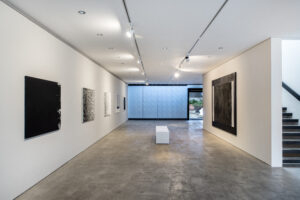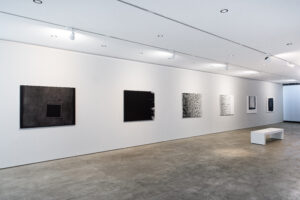

no more no less, recent paintings_ carlos zilio
10 jun - 22 aug_ 2026
What He Does Is Drama: The Recent Paintings of Carlos Zilio
Tadeu Chiarelli
This was my first thought when I encountered the recent paintings of Carlos Zilio: “What he does is drama.”
To associate the artist’s painting with the word “drama” is to cast upon it the entire narrative — extra-pictorial — burden from which a significant portion of Western painting (including, in this context, Brazilian painting and Zilio’s own work) has been attempting to free itself since at least the late nineteenth century.
For centuries, painting — an art “of space” — sought to fulfill one of the roles socially assigned to it: to stage, within a two-dimensional space, actions or situations unfolding in time. I am referring to the subjects imposed upon it: battles, processions, allegorical scenes, genre scenes, and so forth. In other words, for centuries painting was called upon to narrate, within the limitations of its two-dimensional condition, real or fictitious episodes, thus competing — through the adoption of the most diverse (and often controversial) narrative devices — with other artistic forms traditionally considered the arts “of time”: poetry, theatre, music, and literature.
And how did painting stage the world, bringing into two-dimensional space that which unfolds in time and within three-dimensional space? One of its principal strategies was to pursue the illusion of transparency on the picture plane, creating forms of illusionism that made it seem as though, when observing a painting, we were standing before a scene unfolding in real time. Like a fictitious theatrical stage — with two lateral planes, one at the back, and a fourth, transparent plane at the front, the “fourth wall” — painting, for many, was meant to function as a locus for the celebration of gods and goddesses, kings and queens, or else for the representation and theatricalization of the various aspects of reality, whether idealized or not.
It is no coincidence that many painters — such as Titian, El Greco, and Nicolas Poussin, among others — became known for using stage-like models as the basis for their paintings. They would create small wax figures, or figures made from other materials, arranging them upon a platform alongside scenic elements to form a composition. The German scholar Oskar Bätschmann, writing
about this process in Poussin’s work, noted that, after completing the assembly of this kind of miniature theatre, the artist would enclose it within a box (made of wood or cardboard) with six sides, leaving the final side open and positioned downward. Once this was done, the little theatre and its figurines remained sealed inside. Poussin would then make a small hole in the front plane of the box, through which he could observe the scene staged within. Only then would the artist begin to depict what he saw, later deciding whether or not to use the resulting drawing as the basis for a painting.
This act of seeing through — this transparency imposed by the opening in the front plane of the box — reinforced the attempt to make painting behave like a stage2 upon which scenes were narrated as though they were theatre or poetry.
Yet there was something — a kind of blockage — preventing painting from fully functioning as theatrical staging: precisely the fact that it — unlike poetry, theatre, music, and literature — did not unfold in time, but in space. How could one convey the drama of a battle, for instance, within a two-dimensional space? How could one tell a story through painting, given its two-dimensionality?
In the eighteenth century, in response to these questions, the German thinker Gotthold Ephraim Lessing argued that painting, since it could not narrate phenomena unfolding over time, should instead privilege what he called the “fertile moment” (later termed by photography the “decisive moment”).3 In other words, from an entire narrative to be immortalized, the painter should select a particular scene — an episode capable of synthesizing the whole story to be represented. Two Brazilian examples may be cited: Dom Pedro I raising his sword aloft at the “exact moment” he is said to have cried “Independência ou Morte!” would summarize the entire process of the country’s independence, as elaborated and immortalized by Pedro Américo in O Grito do Ipiranga (1888, Museu Paulista da USP, São Paulo); or the priest raising the chalice in Victor Meirelles’s A Primeira Missa no Brasil (1860, Museu Nacional de Belas Artes, Rio de Janeiro) — a possible pictorial condensation produced to celebrate the union between Church and State during the taking possession of Brazilian territory in 1500.
Particularly following the advent of photography — which was believed to represent reality “exactly as it appeared” — painting seems to have begun paying closer attention to the very characteristic that defines it and makes it unique among artistic forms: its planar dimension, already mentioned above. Gradually, it ceased dissolving itself in the creation of illusionistic, scenographic mechanisms and became increasingly concerned with making explicit that its operation did not occur within a fictitious theatrical stage, but rather upon the concrete surface of its support. If we wish to preserve the analogy between painting and theatre, one might say that painting chose to emphasize the “fourth wall” of that false stage.
In a certain sense, what occurred in painting would also take place within theatre itself: theatre, too, began emphasizing the existence of the invisible plane separating audience and stage, along with the need to break with that convention. From that moment onward, the actor begins addressing the audience directly, simultaneously foregrounding and overcoming the convention of the “fourth wall.”5
Particularly from the mid-nineteenth century onward, a similar situation begins to emerge in the work of many painters: rather than exploring painting as an illusionistically deep, “theatrical” space, several artists begin foregrounding the surface of the canvas itself, asserting, so to speak, the reality of that “fourth wall” once used to separate the reality represented upon that simulated stage from the concrete reality surrounding it. And it is precisely there — when the painter foregrounds that “fourth wall,” the pictorial plane itself — that it is ultimately surpassed.
If we turn to the essay Paulo Miyada published on Carlos Zilio’s trajectory,6 we see that, since returning to painting at the turn from the 1970s to the following decade, the artist does not appear interested in “expressing himself.” Having absorbed certain conceptual questions circulating within the artistic and philosophical debates of that period, Zilio takes up painting while reflecting not only upon its making, but equally upon its history and conditions. His focus then seemed to lie in emphasizing the impossibility of that medium (and of art as a whole) expressing the “self,” given that it had become an entirely codified procedure. From the 1980s through the mid-2010s, Zilio produced a body of work driven, in essence, by an extraordinarily rigorous scrutiny of painting’s recent past — that of the twentieth century — guided by a refined and subtle sarcasm employed as an analytical method within his painting practice.
Through this critical lens, the artist “re-read” Volpi, Matisse, and other figures fundamental to twentieth-century art, continually emphasizing the “flattened” character of painting and, always operating at the threshold of the fourth wall, also exploring the ornamental dimension of the works by those artists who most interested him. Abstract Expressionism itself was revisited by Zilio, as though the artist wished to “discipline” it through an awareness, once again, of the impossibility of painting still functioning as a representation of the “self,” having become restricted to the continuous presentation and repetition of previously established codes.7 Up until the 2010s, Zilio’s paintings seemed to insist that, beyond the biting revision of its own constitution, painting itself had no further escape.
However, as Paulo Miyada aptly observes, during the 2010s Zilio breaks with his exclusively critical engagement with painting and its procedures, giving rise to another proposition, whose developments and subsequent unfoldings can be perceived in the exhibition now presented, in 2026, at Galeria Raquel Arnaud. Miyada notes that, throughout that decade, Zilio incorporated an autobiographical component into his poetics — a shift that would open new directions for his painting, which until then had maintained the critical distance already mentioned. And what, precisely, was this component? Let us consider:
at the turn of the 2010s, Zilio […] began insistently and recurrently to introduce an iconic element: the silhouette of an anteater. It […] imposed itself as a kind of phantasmagoria: it was “found” by the artist as an associative sign on the floor at the entrance of his studio; it was systematically schematized as a silhouette and painted dozens upon dozens of times as a shape, a stain, an apparition, or a void within canvases marked by low chromatic saturation and an atmospheric treatment of the pictorial surface.
Miyada continues:
Zilio has shared, on more than one occasion, that the figure of the anteater appears to him as a childhood reminiscence, from the time when his father kept an anteater as a kind of pet. One day, the animal slid down the stair banister and, losing its balance, fell and died. After his father’s death, the artist turned to the image of the anteater as a sign of the persistence of mourning (until 2022, when he painted a black field over its final representation, in the canvas Ausência [Absense])9
As revealing as Zilio’s statements concerning the emergence of the anteater figure may be — and its transformation into a sign to be explored, stemming from a childhood memory — it is difficult to believe (as Miyada himself also suggests) that this entire body of paintings is connected solely, or even primarily, to a kind of expressive outburst motivated by personal memories and experiences
.
What in fact seems to begin in this body of work is an intensification of the debate Zilio had long been conducting with painting and with the history of the medium itself. The figure of the anteater — often evanescent — introduced yet another challenge into his practice: how might one reintroduce the figure of figuration into the field of contemporary painting? How might one continue painting, continue employing the method of critical analysis of the medium itself, while simultaneously flirting with the schematic representation of something — in this case, the image of the anteater?
In these paintings in which the anteater appears, what becomes truly evident is the artist’s play with the boundaries between painting as a field for the exploration of the two-dimensional — of the “fourth wall” so insistently invoked here — and painting’s ancient “vocation” for staging three-dimensional spaces and temporal enactments.
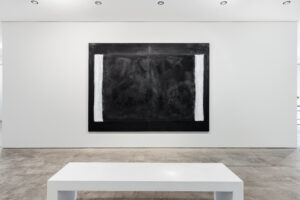
The final painting presented in Carlos Zilio’s retrospective, held in 2025 at Itaú Cultural in São Paulo, was titled Ausência (2022). In it, one could observe — as Paulo Miyada aptly noted in the essay cited above — the schematic figure of an anteater appearing almost entirely submerged beneath a black field. If the work concluded the retrospective, in this new exhibition by Zilio at Galeria Raquel Arnaud, Ausência appears first, chronologically speaking. It is the work that brings us closer to the artist’s most recent production.
If, in Ausência, the figure of the anteater appears almost swallowed by blackness, it is impossible not to wonder about the two vertical, parallel white lines that “seal off” the center of the painting’s surface. Because they were painted over the black field, they emerge somewhat blurred, seeming to belong to a kind of painting understood as a pure exploration of the pictorial surface. And yet they also appear to function as two fissures within that wall, pointing toward “another side,” beyond the black surface.
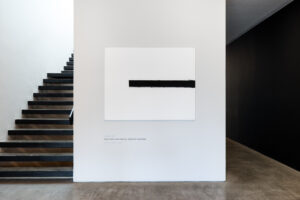
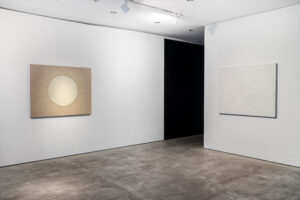
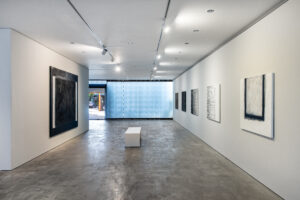
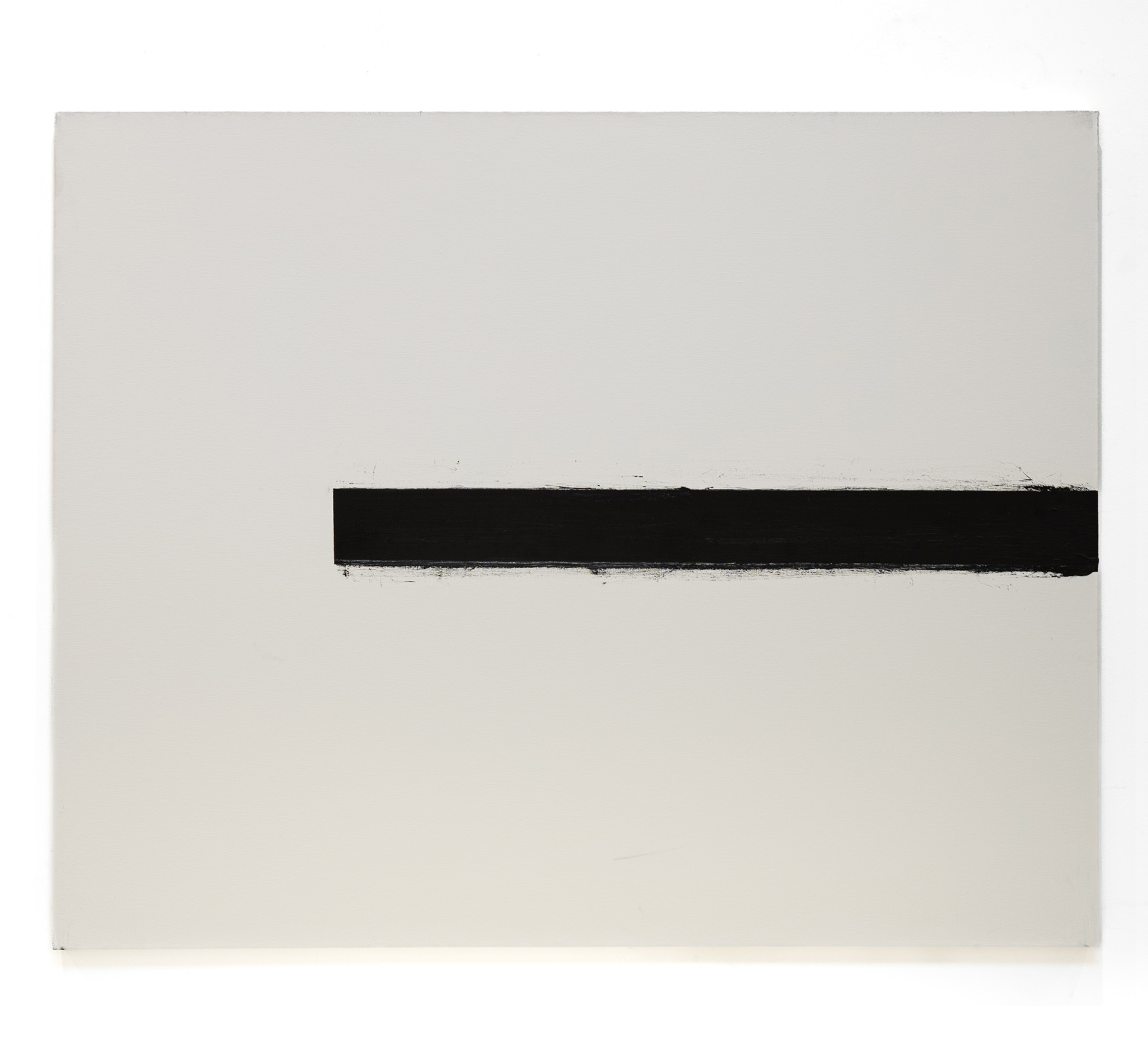
Restricting the palette to black and white is no small matter: paintings at times entirely black, at others entirely white — and others still employing both black and white within the same canvas.
If the entirely monochromatic paintings — rigorous and solemn — continue to revisit the legacy of Western painting, as Zilio has always done, the situation shifts when we encounter the black-and-white works. It shifts because, within them, Zilio seems once again to bring to the foreground — perhaps drawing upon the impact generated by the juxtaposition of black and white — painting as a space for the staging of dramas.
Not the drama that narrates or describes heroic or everyday events, figures or landscapes, portraits or still lifes, but rather the drama of being a two-dimensional platform perpetually open to the possibility of becoming a representational space. A drama that, if no longer the description of a particular scene, is certainly the explicit revelation of its own dramatic condition. And this occurs not only through the contrast between black and white, but also through the exploration of the distinct qualities of those two “colors”: the sense of proximity evoked by black and the sense of distance suggested by white.
In these paintings, all the emphasis and exploration once placed upon the fourth wall seems to give way, once more, to painting understood as a stage — not for a reality beyond itself, but for the staging of its own limits. In other words, Zilio seems intent on reintroducing into painting the possibility of three-dimensional illusion, not in order to employ it as his distant predecessors once did, but rather to continue his critical reflection on the pictorial medium itself.
exhibitions images