
nocturne/ head and feet_ iole de freitas
09 apr - 30 may_ 2026
nocturne/ head and feet
Felipe Scovino
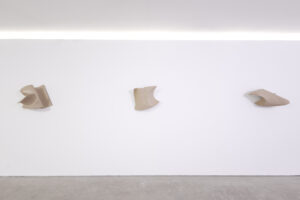
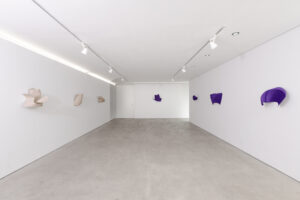
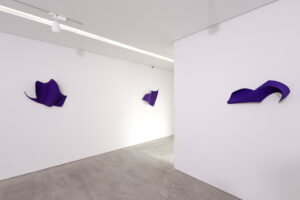
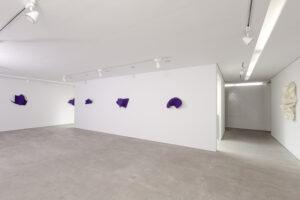
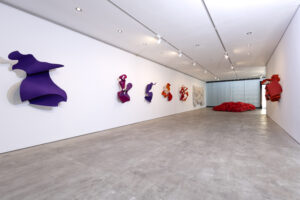
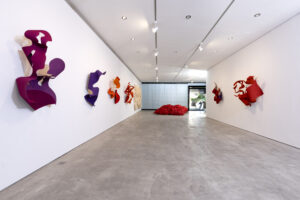
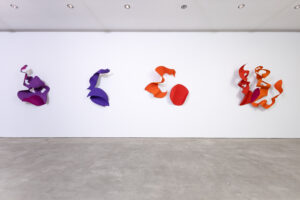
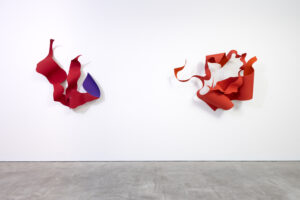
Like a bifurcation where paths intersect, the exhibition unfolds in two parts. On the ground floor, the group of works by Iole de Freitas registers the passage of time within the interval between dusk and sunrise, with color serving as the rhythm of this experience. It is color that renders perceptible the subtle and gradual shifts of this natural movement—from denser, cooler tones to the sublime red that heralds the arrival of another day. The chromatic transitions trace the course from nightfall, marked by the predominance of darker, more muted tones, to daybreak. On the upper floor, a homogeneous darkness prevails, characterized by an indigo, violet hue in the monochromatic works—“the last presence of a certain nocturne before it begins to grow light,” as Iole notes. Between light and darkness, the work offers countless discoveries and contingencies.
Iole constructs her own way of documenting time; it is therefore never rendered present in a predictable manner. Although the exhibition may also be understood as an installation in which the works follow a system or order that gestures toward the interval between night and day, what ultimately matters to the artist is the interrogative capacity the works sustain. Her forms—at times concave, at times convex, often evoking torsos—invite a close, even physical engagement from the viewer. In this way, Iole slows time in order to speak about it. The curvilinear surfaces that interweave planes in a play of concealment and revelation, the vibrant color that intensifies the dynamics of her volumes, the exposure of the hollow or “skeletal” structure of the work, and the expectation of what lies hidden behind—revealed only through the doubt we cast upon what stands before us—are choices that call for a patient, questioning gaze.
It is important to note that there is no emptiness in Iole’s work. The regime of absence does not negate but rather heightens the presence of central conditions such as weight, matter, volume, density, and color—as is also the case with the Aramões, even if they are not included here. Coherence is a defining feature of Iole’s practice, as its fundamental aspects never dissipate. Emptiness acts, intervenes, and becomes an agent of transformation within the relational exchange established between work and viewer. It is in the sinuosity of forms, and in the recesses and gaps of a fragmented structure, that the work truly comes into being. It is a universe of discoveries, with tightly curved forms whose lines we follow in an attempt to discern their end, but also with textures—rugged and smooth, coarse and refined—whose material presence is intensified by the density of color.
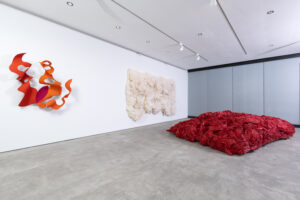
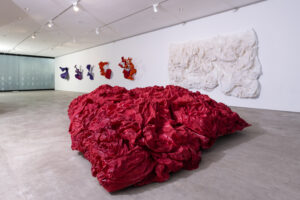
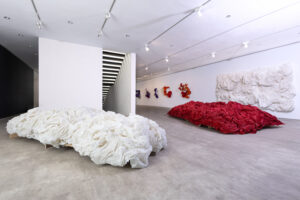
The works also function like the notes of a score or the intervals of silence within a musical composition. Mantos, in particular, synthesizes this subtle vibration, acting as a kind of timbre. Reduced to the bare minimum, despite its scale, the material presence in this series is always discreet and precise. The incidence of white and red—marking the lights that determine the beginning and end of the cyclical duration of the day—acts as a kind of radiating impulse of life. Like a vast monochrome, Mantos, especially in its reddish tones, also evokes the presence of carnality, of a body with its viscera exposed. It falls to the viewer to traverse, with the eye, the density of this body, with its furrowed and slightly velvety surface. As in a lesson in anatomy, or an allegorical measure of time, it stands there, ready to be dissected.
We witness a transition of light and are immersed in a process in which time is held within a state of slowness; where the organic forms of these sculptures allow us to perceive the passage of this natural phenomenon from other perspectives. By speculating on their topology and chromatic range, we investigate, with greater precision and deliberation, the relationship between volume and color. It is as though time and light were to acquire, even if symbolically, a kind of materiality—or perhaps carnality—now placed in dialogue with the viewer’s body.
The passage through the many tones of violet, orange, coral, red, and finally the incarnate light of the Manto rubro conditions not only a temporal structure but also foregrounds color as the very marker of this event, one that belongs to the order of transcendence. Yet, although a sequential order may be discerned, the works retain their autonomy. There is also the exercise of a theatricality that unfolds in various ways: beyond the composition of these acts that lead to the experience of daybreak, as noted earlier, the artist invests in a spatial arrangement of forms that ultimately emphasizes a dramatic dimension. Movement never ceases; everything vibrates, even if the temporal regime of these changes unfolds in a mode of gentleness. The way the work is installed, for instance, gives rise to a diagonal that induces dynamism. Through the sectioning of its planes, an operation is traced: volumes are opened to speculation, revealing curves whose ends we cannot see, but only imagine in their continuation. A play of visualities emerges, depending on the point of view adopted, oscillating between openness and subtle occlusion. The forms snake and wind—like a body in motion—to such an extent that the work seems to leave fragments of itself behind.
The theatrical dimension also emerges in the operation of vertigo that the works announce. There is an imminent sense of a fall because the sculptural body—recalling the image of the torso—exists in a state of toppling. It is not just any body: as the exhibition’s title itself suggests, it is mutilated. Headless and inert, this body collapses. The more slender and pointed elements—particularly in the series informally referred to by the artist as Descabeladas or Algas—crumple, intensifying the dramatic experience. The organic plasticity of these works moves toward an unsettling, even disquieting atmosphere. Iole’s research has historically been shaped by the index of a fragmented body. The fragmentation present in her early photographs and films acquires here a new, denser, more plastic dimension—one in which weight, gravity, and, of course, color become increasingly operative and held in tension, without the need for a literal reference to the human body. Films such as Light Work explore the state of translucency of matter in an environment where everything seems to dissolve, as well as the artist’s own body, which appears as the image of a shadow, a hiatus between presence and absence. The threat of this condition of fragmentation—revealed through the image of a specter—is brought, as a kind of parable (with all its specificities), into the body of work presented in this exhibition. We might even perceive, why not, specters of light that merge with bodies.
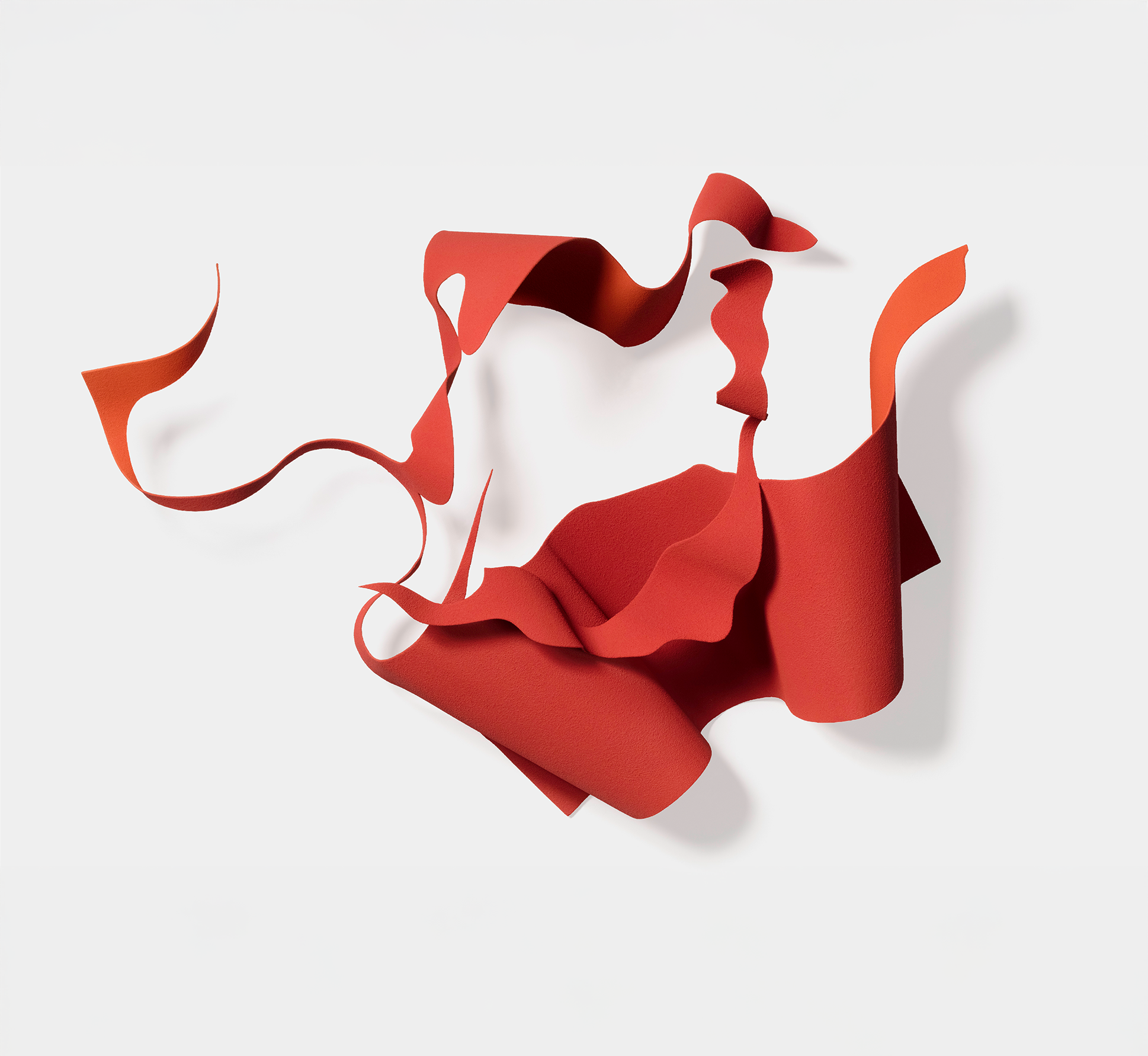
When Iole renders steel flexible—a material typically associated with the industrial field—another quality emerges. In this operation, a gestural force that curves the line is combined with a pictorial investment that escapes a precise and predetermined rationality. In general, with few points of fixation, its arching, transparent, and seductive form vigorously resists orthogonal framing and seeks—through its twists, and through a structure that reinforces its condition as a fragment, sustaining the sense that it belongs to something far greater than what we see—a space beyond the limits of the planar surface.
The horizon—a field always to be woven, unstable in its permanence—is less a place conceived within the exhibition than an idealization. To engender the mobility of a line, and simultaneously of a fleeting time, is one of Iole’s central interests, translated here into the experience of alluding to a “nocturnal horizon.” The formation of a kind of continuous line, positioned close to the viewer’s eye, intensifies this conception of landscape under the regime of darkness, in contrast to the solar experience of the ground floor. Above all, however, it draws the viewer into a more intimate proximity with this phenomenological adventure, in which steel becomes metaphorically a body.
This symbolic register gains further consistency in the way lines become flexuous gestures; there is a decisive and sustained investment of the artist’s hand in the fluid construction of the line, alongside her chromatic choices. Torsion becomes the expression of an unresolved tension and of an inevitable gesture of change. These maneuvers are folds in space that cause the work to expand, to grow, and to demand—regardless of its scale—ever more room in which to “breathe.” The gesturality of the lines approaches a kind of dance, recalling the artist’s original formation, and incorporates torsion into a vocabulary in which contradictions come to the fore: a body that moves within a space at once precise and elusive, raw and lyrical, tense and distended, substantively present without relinquishing a certain quality of enchantment. And it is not “only” the body that sways—color, too, registers what is in transit. It runs across the surface, emitting a powerful light that radiates throughout the space. This is the moment when color seems to float, accentuating an expansive quality that extends beyond the plane of the image.
The subtle chromatic variations of the works on the ground floor, or the monochromes of the upper level—like chords that construct space and reinforce the exhibition’s theatrical dimension—correspond to the measure of time that Iole seeks to manifest: a time measured through the structure of lived experience and therefore not processed in a linear manner. The curves of the works that metaphorically collapse, or withdraw, projecting an end that cannot be seen, are symptoms of this experience of time—one that is projected by us, rather than empirically calculated.
exhibitions images